



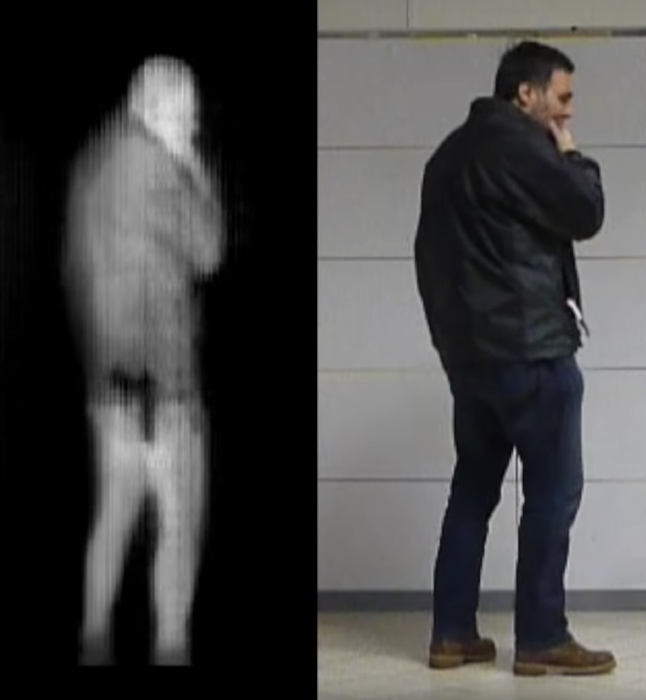
"A new technique uses long-wavelength infrared radiation to produce video with a high frame rate, which could be useful for nondestructive testing of productssdf."
"Researchers generated video at 3000 frames per second using so-called terahertz radiation, waves at the long-wavelength end of the infrared region of the electromagnetic spectrum. To capture images rapidly, they first passed the radiation through a cloud of excited cesium atoms to convert it into green light, which allowed them to use a standard optical camera. The work opens up a new avenue for noninvasive imaging, potentially allowing engineers to peer inside products as they move through a production line."
"In theory, terahertz signals—which have wavelengths between roughly 30 micrometers and 3 mm—are ideal for nondestructive examination of products from production lines. These waves can pass through fabrics, plastics, and paper, and at the same time are nonionizing, which means that, unlike x rays, they don’t carry enough energy to remove electrons from atoms and molecules. But in practice, this range of wavelengths is difficult to detect, compared with shorter and longer wavelengths. Additionally, sources of terahertz waves tend to operate at lower power than those in other parts of the electromagnetic spectrum, and terahertz detectors are less sensitive. While terahertz imaging technologies exist, they can’t capture images rapidly and at high resolution."
"Instead of trying to address the limitations of current technology, Kevin Weatherill and his colleagues at Durham University in the UK tried a different approach, explains team member and graduate student Lucy Downes. “We convert the terahertz photons into visible photons, [so] we can make use of already very well-developed optical high-speed camera technologies.”"